Review Paper by Faculty and Students of the School of Chemical Engineering and Pharmacy Published in Top International Journal Coordination Chemistry Reviews
News Release (Correspondent: Guo Juan) Recently, the research team led by Professor Gu Shuangxi from the School of Chemical Engineering and Pharmacy of our university published a review article titled Fluorescent probes for chiral recognition of free amino acids: Design strategies, signaling mechanisms, and emerging trends in Coordination Chemistry Reviews (Impact Factor: 25.6, Q1 Top Journal in Chinese Academy of Sciences Journal Partition).Wuhan Institute of Technology is the sole institutional affiliation of this work. Master’s students Hou Zelong and Tan Yuying (School of Chemical Engineering and Pharmacy) act as co-first authors. Co-corresponding authors include Associate Professor Li Yang, Professor Gu Shuangxi (School of Chemical Engineering and Pharmacy), and Professor Zhu Yuanyuan (School of Chemistry and Environmental Engineering).
In nature, numerous bio-chemical reactions occurring in living organisms are closely associated with chiral recognition. As fundamental building blocks of life, chiral amino acids play an indispensable role in life science, medicinal chemistry, chiral chemistry and other disciplines. Nevertheless, achieving rapid, sensitive and real-time enantiomeric identification of free amino acids remains a critical analytical bottleneck.Compared with traditional chromatographic and electrophoretic techniques, chiral recognition strategies based on fluorescent probes possess prominent merits including high sensitivity, fast response, simple operation and capability for real-time in-situ detection. They hold broad application prospects for amino acid analysis in biological systems, food, pharmaceutical products, industrial chemicals and related fields.
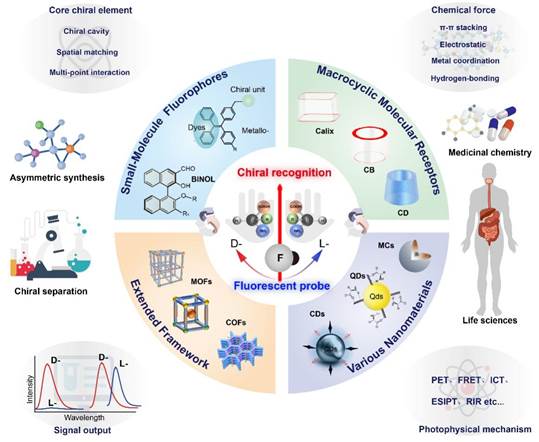
This review systematically sorts out state-of-the-art research progress on chiral fluorescent probes for free amino acid recognition, establishes correlations between molecular design strategies and signal transduction mechanisms, and elaborates how coordination chemistry and supramolecular interactions work in tandem to realize highly enantioselective fluorescent signals.The authors categorize existing probe systems into four major groups: small organic molecules (BINOL and other fluorophore-based platforms), macrocyclic receptors (cyclodextrins, cucurbiturils, calixarenes), extended frameworks (metal–organic frameworks and covalent organic frameworks), and various nanomaterials (carbon dots, quantum dots, silicon nanoparticles, polymer dots).Meanwhile, it thoroughly analyzes photophysical mechanisms including photoinduced electron transfer, intramolecular charge transfer, fluorescence resonance energy transfer, excited-state intramolecular proton transfer, and aggregation-induced emission, and reveals the intrinsic rules by which host–guest chiral recognition is converted into signals of fluorescence intensity variation or wavelength shift.
In addition, the paper critically discusses key challenges currently confronting this field, such as universal applicability, biocompatibility and in vivo imaging, and prospects emerging research directions including machine learning-assisted probe design, catalytic signal amplification, and point-of-care testing devices. This review provides theoretical guidance and innovative ideas for the design and development of new-generation high-performance chiral fluorescence sensing platforms.
In recent years, Professor Gu’s team has conducted in-depth research on chiral fluorescent recognition and analysis, publishing numerous high-level articles in journals such as Nature Communications (2026), Chinese Chemical Letters (2026, 2024, 2023), Chiral Chemistry (2026), Sensors and Actuators B: Chemical (2025), Dyes and Pigments (2025, 2024), Journal of the American Chemical Society (2019), and Chemistry – A European Journal (2019). The team has also filed multiple Chinese invention patents, two of which have been licensed for technology transfer.Meanwhile, Professor Gu Shuangxi’s group has cultivated numerous outstanding students in this field.For example, Fu Shiwei, a master’s graduate of the 2021 cohort, received a full scholarship to pursue his doctoral degree at the University of Miami after graduation, and began postdoctoral work at an affiliated hospital of Harvard University in May 2026.
(Reviewer: Xiong Qingang)
Paper Link: https://www.sciencedirect.com/science/article/pii/S0010854526006533?dgcid