Review Article by Young Faculty Members of the School of Chemical Engineering and Pharmacy Published in Top
International Journal Coordination Chemistry Reviews
News Release (Correspondents: Huang Yi, Zeng Lei) Recently, young faculty Drs. Huang Yi and Zeng Lei from the School of Chemical Engineering and Pharmacy published a review paper titled “Gradient Doping in Photocatalysts: Synthesis Strategies, Characterization Techniques, and Application in Photocatalytic Reactions” in Coordination Chemistry Reviews (IF = 25.6, Q1 Top Journal in CAS Journal Ranking).Wuhan Institute of Technology is designated as the first institutional affiliation of this work. Dr. Huang Yi (School of Chemical Engineering and Pharmacy) acts as the sole first author. Co-corresponding authors include Dr. Zeng Lei (School of Chemical Engineering and Pharmacy), Professor Wang Huihu (Hubei University of Technology) and Professor Huang Limin (Southern University of Science and Technology).
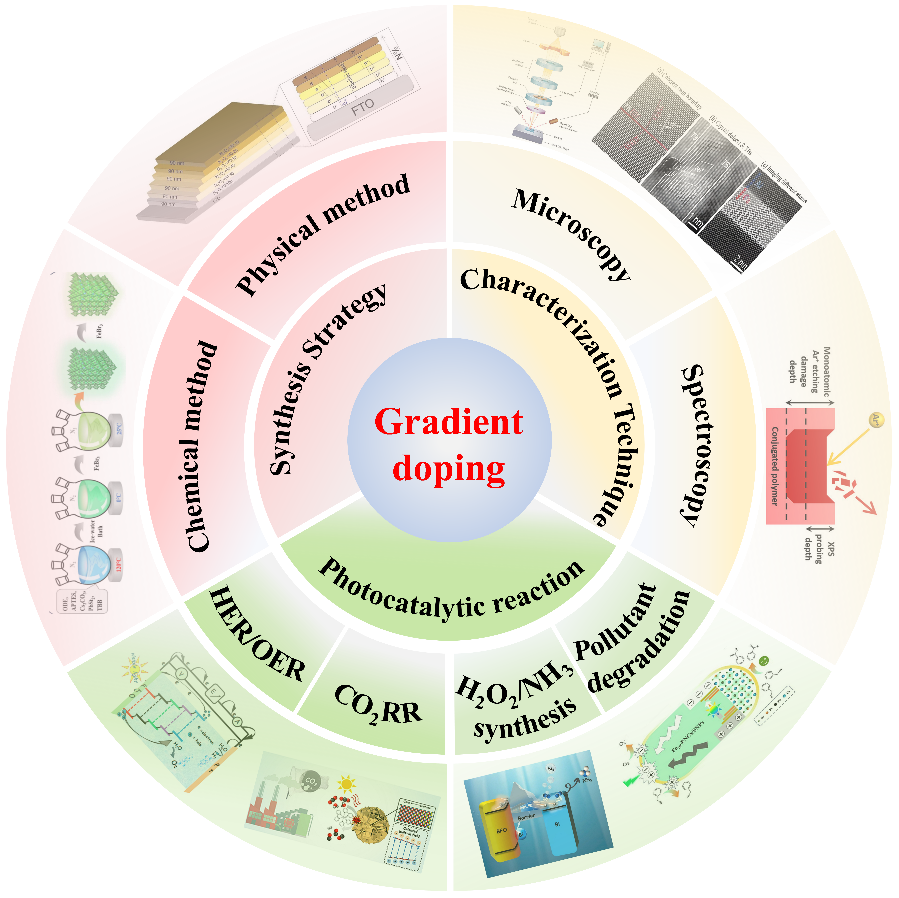
In photocatalysis research, the rapid recombination of photogenerated carriers severely limits energy conversion efficiency. Although conventional uniform doping can modulate band structures, it tends to introduce recombination centers and thus fails to achieve efficient spatial charge separation. Gradient doping constructs a continuous dopant concentration gradient within materials, which triggers steady band bending and forms an internal built-in electric field, delivering an innovative route to directional charge separation. This review systematically summarizes the research progress of gradient-doped photocatalysts. It focuses on two categories of synthetic strategies: chemical methods (liquid-phase diffusion, gas-solid reaction, solid-phase diffusion, etc.) and physical methods (spin coating, pulsed laser deposition, atomic layer deposition, etc.), and elaborates the formation mechanisms and regulation rules of gradient distribution. The paper also summarizes the applicability and limitations of advanced characterization techniques such as depth-resolved XPS, TOF-SIMS and STEM-EDX for quantitative analysis of doping gradients. By integrating typical application scenarios such as water splitting, CO₂ reduction and organic pollutant degradation, the work uncovers the intrinsic working mechanism of gradient doping: it optimizes band structures, suppresses bulk carrier recombination and accelerates surface reaction kinetics.
The paper further points out that current research on gradient doping still faces multiple challenges, including ambiguous conceptual definitions, a lack of characterization techniques to verify dopant gradient distribution within single particles, and unclear mechanisms of gradient effects in organic photocatalysts. In the future, it is necessary to develop novel synthetic approaches, establish standardized characterization procedures for gradient doping, and explore its application potential in organic photocatalytic materials. This review provides a theoretical framework and technical routes for the design and development of gradient-doped photocatalysts, which is of great significance for promoting the efficient conversion of solar energy.
(Reviewer: Gu Shuangxi)
Full-text Link: https://doi.org/10.1016/j.ccr.2026.218260